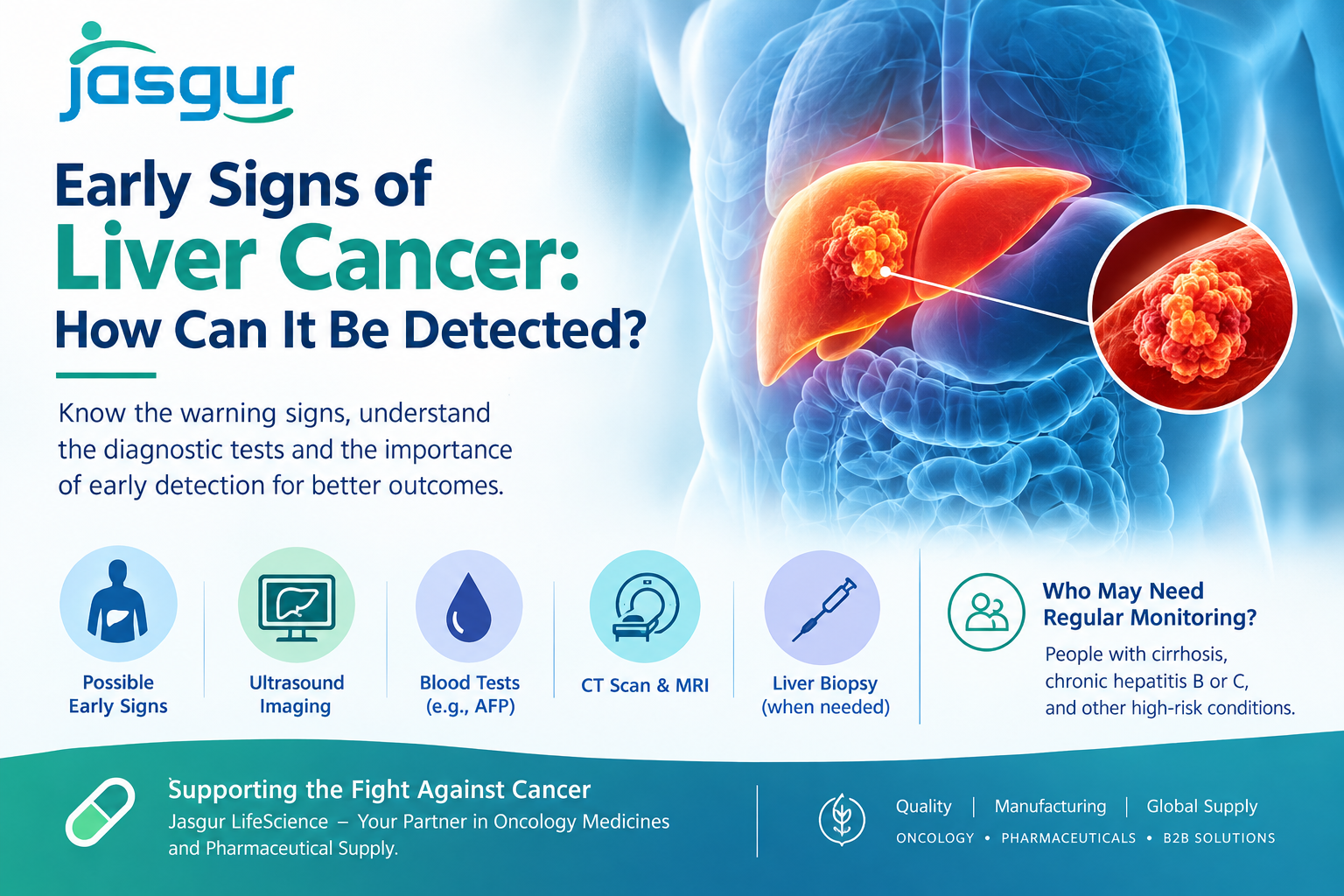
Early Signs of Liver Cancer: How Can It Be Detected ?
Liver cancer can be difficult to identify in its early stages because noticeable symptoms may not appear until the disease has progressed. However, recognizing possible warning signs and understanding how liver cancer is detected can encourage timely medical evaluation. According to the National Cancer Institute (NCI), liver cancer may be investigated through blood tests, imaging examinations, and, when appropriate, a biopsy.
For businesses looking for an Anti Cancer Medicines Supplier, understanding liver cancer and its diagnosis is also important when developing reliable oncology medicine supply channels. Jasgur LifeScience supports the pharmaceutical sector with a focus on oncology products and pharmaceutical manufacturing and supply.
What Are the Early Signs of Liver Cancer?
Liver cancer does not always produce clear early symptoms. When symptoms do occur, they can include unexplained weight loss, reduced appetite, feeling full after eating a small amount, nausea or vomiting, abdominal discomfort, swelling of the abdomen, and pain around the upper right side of the abdomen. Jaundice, which causes yellowing of the skin and whites of the eyes, can also occur.
Other possible symptoms include itching, fever, unusual bruising or bleeding, and an enlarged liver or spleen. Importantly, these symptoms do not automatically indicate liver cancer because several other medical conditions can cause similar problems. A medical professional should evaluate persistent or unusual symptoms.
How Is Liver Cancer Detected?
There is no single test that can identify every case of liver cancer. Doctors generally consider a person's medical history, symptoms, physical examination, laboratory results, and imaging findings when investigating a possible diagnosis.
1. Ultrasound
An ultrasound uses sound waves to create images of the liver. It can help identify abnormal areas or masses and is commonly used when examining the liver. For people at increased risk, ultrasound may be included in regular surveillance.
2. Blood Tests
Blood tests can provide information about liver function and may include an alpha-fetoprotein (AFP) test. AFP can be elevated in some people with liver cancer, but it can also increase because of other conditions. Furthermore, some people with liver cancer have normal AFP levels, so an AFP test alone can not confirm or rule out liver cancer.
3. CT Scan and MRI
If an abnormal area is identified, doctors may use contrast-enhanced CT or MRI to obtain more detailed images of the liver. These imaging techniques can help doctors examine the size, location, and characteristics of a liver lesion and determine whether additional testing is necessary.
4. Liver Biopsy
In selected situations, a biopsy may be performed. During a biopsy, a small tissue sample is collected and examined under a microscope for cancer cells. However, a biopsy is not required in every suspected liver cancer case; doctors may sometimes establish a diagnosis based on characteristic imaging findings and the patient's clinical situation.
Who May Need Regular Monitoring?
Routine liver cancer screening is not generally recommended for people at average risk. However, people at higher risk, including some individuals with cirrhosis or chronic hepatitis B, may be monitored more closely. Some expert recommendations use liver ultrasound with or without AFP testing at regular intervals for selected high-risk groups.
Anyone experiencing persistent symptoms or who has known liver disease should discuss appropriate monitoring and diagnostic tests with a qualified healthcare professional.
Role of Oncology Medicine Manufacturing in India
India has an established pharmaceutical manufacturing sector that supplies medicines to domestic and international markets. Oncology Medicine Manufacturing in India covers the development and production of medicines used across different cancer-care settings, subject to applicable regulatory and quality requirements.
For pharmaceutical distributors, importers, hospitals, and healthcare businesses, choosing an experienced Anti Cancer Medicines Supplier can be an important part of maintaining dependable medicine supply chains. Jasgur LifeScience focuses on pharmaceutical and oncology product manufacturing and supply for B2B requirements and international markets.
FAQs
Q1. What are the early signs of liver cancer?
A1: Early liver cancer may not cause noticeable symptoms. Possible signs include unexplained weight loss, loss of appetite, upper abdominal discomfort, nausea, abdominal swelling, and jaundice.
Q2. How is liver cancer detected?
A2: Doctors may use medical history, physical examination, blood tests, ultrasound, CT scans, MRI, and, in selected cases, a liver biopsy to investigate suspected liver cancer.
Q3. Can a blood test confirm liver cancer?
A3: A blood test alone can not usually confirm liver cancer. Alpha-fetoprotein (AFP) may be measured, but elevated or normal AFP levels do not by themselves establish or exclude a diagnosis.
Q4. Who has a higher risk of developing liver cancer?
A4: People with certain chronic liver conditions, including cirrhosis and chronic hepatitis B or hepatitis C infection, may have a higher risk. Individual risk varies and should be assessed by a healthcare professional.
Q5. Can liver cancer be detected before symptoms appear?
A5: Yes. People at increased risk may undergo regular surveillance using appropriate tests, which can sometimes identify liver cancer before symptoms develop.
Conclusion
Recognizing possible signs of liver cancer is important, but symptoms alone can not establish a diagnosis. Unexplained weight loss, appetite changes, abdominal discomfort, swelling, jaundice, or other persistent symptoms should be discussed with a healthcare professional. Depending on individual risk factors, doctors may use ultrasound, blood tests such as AFP, CT, MRI, and sometimes biopsy to investigate liver abnormalities.
For pharmaceutical businesses seeking an Anti Cancer Medicines Supplier, Jasgur LifeScience provides a B2B-focused pharmaceutical supply and oncology manufacturing approach designed to support healthcare and distribution requirements.